The 2026 Guide to AI Agents
This 2026 guide explores AI agents, explaining how they execute active workflows across industries.
// Opening:
01. Introduction to AI Agents:
For the better part of three years, the story of generative AI was a story about conversation. You typed something in, and a model typed something back. Smarter, faster, more fluent every year — but fundamentally a one-way exchange of words. In 2026, that story has changed. The defining shift in AI this year isn't a bigger model or a longer context window — it's the move from AI that talks to AI that acts.
An AI agent doesn't just answer your question about quarterly revenue — it logs into your accounting system, pulls the numbers, cross-references them against last year's figures, flags the anomaly, drafts the explanation, and routes it to the right person for approval. It doesn't just suggest a flight — it checks your calendar, compares five airlines, books the one that fits your loyalty program, and emails you the confirmation. This is what the industry now calls agentic AI, and by 2026, it will have moved from research demos to systems making real decisions inside hospitals, banks, supply chains, and emergency response centers.
This guide is built for two audiences at once: builders who need a technically accurate map of how these systems actually work — the reasoning loops, the architectures, the frameworks — and business leaders or curious readers who want to understand what's changing without wading through a research paper. By the end, you'll know what separates a true AI agent from a glorified chatbot, how agents reason and act through tools, the five classical types of agents and where each shows up in the real world, where agentic AI is already paying off, and — just as importantly — the risks that come with handing decisions to autonomous software.
// Definition:
02. What Are AI Agents?
- An AI agent is a system that autonomously performs tasks by designing workflows with available tools and making decisions on its own, rather than simply generating a response and waiting for the next human prompt. AI agents can encompass a wide range of functions beyond natural language processing, including decision-making, problem-solving, interacting with external environments, and performing actions in the real world or across software systems.
- Put another way: an AI agent is a software component that has the agency to act on behalf of a user or a system to perform tasks, and users can organize agents into systems that orchestrate complex workflows, coordinate activities among multiple agents, apply logic to thorny problems, and evaluate the answers to user queries.
2.1 How This Differs from a Standard Chatbot or LLM Call:
- A traditional chatbot — even one built on a frontier LLM — operates in a single, bounded exchange: you ask, it answers, the interaction ends. It has no persistent memory of what it did five minutes ago beyond the current conversation window, no ability to independently decide to check three different sources before answering, and critically, no ability to actually do anything outside generating text. Put simply, AI agents are artificial intelligence systems that use tools to accomplish goals — they can remember across tasks and changing states, use one or more AI models to complete tasks, and decide when to access internal or external systems on a user's behalf.
- This is the core distinction worth holding onto throughout this guide: a standard LLM call produces an output. An AI agent pursues an outcome — deciding, often without further human input, what steps are needed, which tools to use, and when the goal has actually been achieved.
The one-line distinction: AI agents decide on the best course of action by considering goals, roles, and constraints, and they can update their plans in real time as things change — making them more adaptable to process change and edge cases than older techniques like robotic process automation.
// The Mechanics:
03. How AI Agents Work?
At the core of most AI agents are large language models, which is why agents are often called LLM agents. A traditional LLM produces its responses based purely on the data used to train it, bounded by knowledge and reasoning limitations frozen at training time. Agentic technology changes this by using a tool called on the backend to obtain up-to-date information, optimize workflows, and create subtasks autonomously to achieve complex goals — and crucially, the agent learns to adapt to user expectations over time, storing past interactions in memory to encourage a more personalized, comprehensive response.
This entire process breaks down into three stages, sometimes called the core agentic components.

3.1. Goal Initialization and Planning:
- Although AI agents are autonomous in their decision-making, they require goals and predefined rules defined by humans. There are three main influences on autonomous agent behavior: the team of developers that design and train the system, the team that deploys the agent and provides user access, and the user who supplies specific goals and establishes available tools. Given the user's goals and the agent's available tools, the agent then performs task decomposition — creating a plan of specific tasks and subtasks to accomplish the complex goal. For simple tasks, this planning step isn't always necessary; an agent can instead iteratively reflect on its responses and improve them without planning.
3.2. Reasoning with Available Tools:
- AI agents base their actions on the information they perceive, but they often lack the full knowledge required to tackle every subtask within a complex goal. To bridge this gap, they turn to available tools — external datasets, web searches, APIs, and even other agents — deciding in real time which tool is needed for the step at hand, executing the call, and incorporating the result back into its reasoning before deciding on the next step.
3.3. Learning and Reflection:
- After acting, the agent's ability to store past interactions in memory and plan future actions encourages a more personalized experience and comprehensive responses over time. The agent system may iteratively improve its output, requesting additional input to ensure accuracy and relevance, and once a final output is delivered, the system may request feedback. Constructive feedback loops allow agents to review and refine their own work — a critic specialist agent, for example, can review a plan created by a creator agent and ask for iterations, often producing better outputs than either agent working alone.
// The Divide:
04. Agentic vs. Non-Agentic AI Chatbots
It's easy to assume that any AI-powered chat interface is "agentic" by default in 2026 — but the distinction matters enormously, both for what these systems can actually do and for how much oversight they require. A non-agentic chatbot, no matter how sophisticated its language model, fundamentally responds. An agentic system fundamentally acts.

| Dimension | Non-Agentic Chatbot | Agentic AI |
|---|---|---|
| Core behavior | Responds to a single prompt with generated text | Pursues a goal through planning, decision-making, and multi-step action |
| Memory | Limited to the current conversation window | Persists across tasks and changing states, informing future decisions |
| Tool use | None, or a single fixed tool integration | Dynamically selects from multiple tools, APIs, or even other agents |
| Autonomy | Waits for the next human prompt after every reply | Can take multiple sequential actions without waiting for further input |
| Adaptability | Fixed responses based on patterns in training data | Updates plans in real time as circumstances change |
| Best fit | Q&A, drafting, simple lookups, FAQ-style support | Multi-step workflows: research, transactions, orchestration, monitoring |
Traditional automation follows fixed rules, and generative AI produces content in response to prompts. Agentic AI, by contrast, can interpret goals, make decisions, and take actions across multiple steps to achieve a determined outcome — which is precisely why it requires a different category of oversight than either of its predecessors.
// Under the Hood:
05. Reasoning Paradigms: ReAct & ReWOO:
Once an agent decides it needs to use tools, it has to follow some structured reasoning pattern to do so reliably. Two paradigms dominate production agent design in 2026, and they represent a genuine trade-off between adaptability and efficiency.
5.1. ReAct (Reasoning and Action):
ReAct agents operate in a reason-act-observe loop that repeats until the agent resolves the query. The pattern runs Thought → Action → Observation → Thought → Action → Observation, continuing until the agent decides it has enough information to answer. At each step, the model reasons about the situation, decides on the next best action — often calling a tool — executes it, and then observes the result before reasoning again. This tight loop is what makes ReAct so adaptable: because the agent reasons fresh after every observation, it can change course immediately if a search returns unexpected results or a tool call fails.

The drawback is cost and latency: because ReAct interleaves reasoning with every tool call, each subsequent call must include all the conversation history that precedes it — a cost that compounds with each additional step. This makes it the workhorse for dynamic, interactive applications, but expensive at scale for long, predictable workflows.
5.2. ReWOO (Reasoning Without Observation):
ReWOO breaks away from the think-act-observe pattern entirely by decoupling reasoning from external observations, allowing the model to plan its full chain of reasoning internally before selectively invoking any tools. Rather than reasoning, acting, and observing in a tight loop, ReWOO divides the process into three distinct modules: a Planner, which uses the model's reasoning ability to create a complete solution blueprint upfront, with placeholders for data it doesn't have yet; a Worker, which executes the plan and collects evidence by calling external tools or APIs — often in parallel; and a Solver, which integrates all the gathered results into a final answer.

Because ReWOO doesn't interleave reasoning with tool calls, it uses significantly fewer tokens than ReAct on multi-step tasks — benchmarks show reductions of 30 to 50% compared to ReAct on equivalent workflows, making it meaningfully cheaper to run at scale. The trade-off is rigidity: because the plan is fixed upfront, ReWOO can break if a tool returns something unexpected, since there's no mid-execution reasoning step to adapt the plan.
When to use which: reach for ReWOO when your task steps are predictable and don't require mid-execution reasoning adjustments — research synthesis, report generation, well-defined data pipelines. Reach for ReAct when the agent needs to adapt dynamically — open-ended troubleshooting, exploratory research, or any task where a tool's output might genuinely change the next best step.
// The Taxonomy:
06. Types of AI Agents:
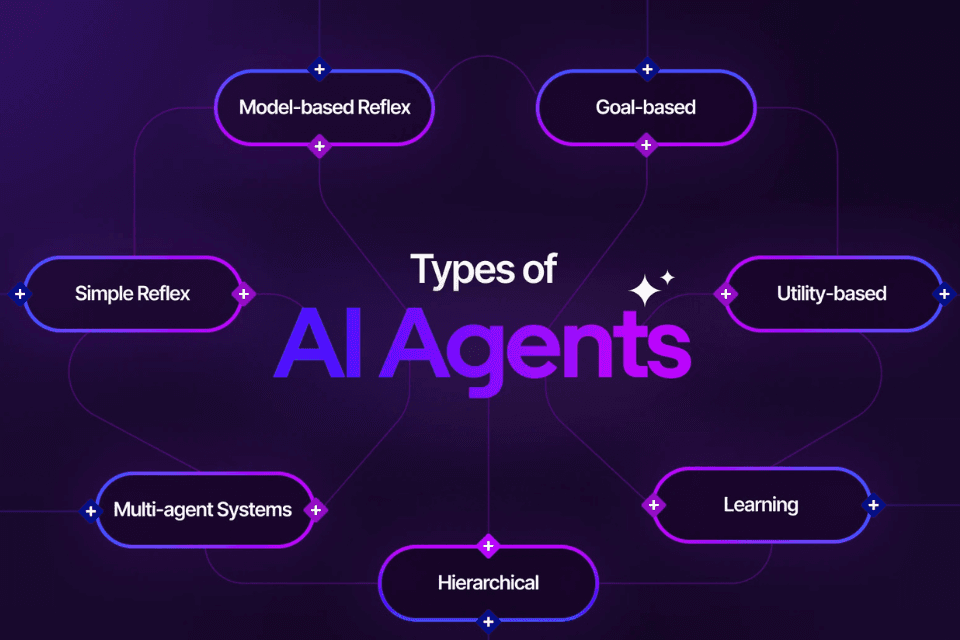
AI agents are classified based on their level of intelligence, decision-making processes, and how they interact with their surroundings to reach a desired outcome. Some agents operate purely on predefined rules, while others use learning algorithms to refine their behavior over time. There are five main types, and importantly, all five can be deployed together as part of a multi-agent system, with each agent specializing in the part of the task for which it's best suited.
6.1. Simple Reflex Agents:
The most basic type, designed to operate based on direct responses to environmental conditions using predefined condition-action rules — without considering past experiences or future consequences. Reflex agents apply current perceptions of the environment through sensors and act based on a fixed set of rules. They're effective in structured, predictable environments but struggle in dynamic scenarios that require memory or long-term planning, and because they store no past information, they can repeatedly make the same mistakes if the rules are insufficient for new situations.
Real-World Example: A thermostat that turns on the heater when the temperature drops below a threshold and off once the target is reached. An automatic traffic light system that adjusts signals purely in response to current sensor inputs, without reference to past traffic states.
6.2. Model-Based Reflex Agents:
A more advanced version of the simple reflex agent. While it still relies on condition-action rules to decide, it also incorporates an internal model of the world that helps the agent track the current state of its environment and understand how past interactions might have impacted it — allowing for more informed decisions. Unlike simple reflex agents, which respond solely to current sensory input, model-based agents can reason about aspects of the environment they can't directly perceive at the moment.
Real-World Example: A robotic vacuum that maintains an internal map of a room, remembering which areas it has already cleaned and avoiding previously identified obstacles, rather than reacting blindly to whatever its sensors detect at each instant.
6.3. Goal-Based Agents:
A goal-based agent incorporates a proactive, goal-oriented approach to problem-solving, exceeding simpler reflex agents by adding a planning function that considers future states. In the hierarchy of agent complexity, goal-based agents sit squarely in the middle — more complex than reflex agents, but less complex than utility-based agents (which compute trade-offs) or learning agents (which adapt over time). These agents maintain explicit representations of desired states and systematically work toward achieving them, often relying on preprogrammed strategies and decision trees while considering future states to coordinate complex, multi-step processes — and if a step is delayed, the planning module can re-run and formulate a new plan.
Real-World Example: A hospital's patient scheduling agent coordinating labs, medicine timing, and specialist sign-offs toward the goal of completing a treatment plan — re-planning automatically whenever a step is delayed rather than simply failing.
6.4. Utility-Based Agents:
A utility-based agent uses a mathematical utility function to make rational decisions by maximizing the expected utility, or "happiness," of possible outcomes — assigning a numerical value to each potential outcome and quantifying the agent's preferences. Unlike a goal-based agent, which works toward a single binary objective, a utility-based agent recognizes that some outcomes are better than others even when both technically "achieve the goal," and naturally handles competing objectives by encoding them directly into the utility function. These agents are ideal for complex tasks with multiple competing directives.
A hospital's Bed Assignment Optimizer that assigns patients to rooms while simultaneously weighing safety, contagiousness, staffing levels, and patient satisfaction — trade-offs a simple goal-based agent couldn't navigate. Self-driving cars similarly weigh competing factors like speed, safety, and passenger comfort in real time.
6.5. Learning Agents:
At the highest level of the hierarchy, learning agents employ machine learning to seek patterns from experience and improve their own performance over time, operating in unfamiliar environments and acquiring capabilities beyond their initial knowledge base. Learning agents typically consist of four components: a learning element that improves the agent's knowledge from its precepts and sensors, a critic that provides feedback on whether the quality of responses meets the performance standard, a performance element responsible for selecting actions, and a problem generator that proposes new actions to try. Learning agents might be utility-based or goal-based in their underlying reasoning.
Real-World Example: A hospital intake assistant who learns from experience to improve triage questions, flag high-risk patients earlier, and reduce redundant steps over time. E-commerce recommendation engines that track user activity and preferences, continuously refining suggestions as new behavioral data arrives.
These types stack in production. A real factory floor might use goal-based agents to drive specific objectives like optimizing production schedules, utility-based agents to weigh energy consumption against cost efficiency and production speed, and learning agents to continuously analyze data patterns and suggest workflow improvements — all working together as one multi-agent system.
// In Production:
07. Use Cases of AI Agents:
Agentic AI has moved from experimental to operational in 2026. A growing share of enterprise applications now embed task-specific agents across customer operations, finance, supply chain, healthcare, and emergency response — allowing businesses to scale complex processes without a proportional increase in headcount. Here's where the impact is most concrete.
7.1. Customer Experience:
Customer service has become one of the most mature and widely deployed agentic use cases — resolving support queries, handling returns, and managing escalations with minimal human intervention. Organizations using gen-AI-enabled customer service agents have seen issue resolution increase by 14% per hour, with a 9% reduction in time spent handling issues.
Real-World Example: A leading consumer packaged goods company used intelligent agents to create blog and marketing content, reducing costs by 95% and improving speed by 50x compared to traditional production cycles — freeing human marketers to focus on strategy rather than first-draft production.
7.2. Healthcare:
In healthcare, agents are increasingly involved in patient flow management, clinical documentation, and treatment planning — domains where the cost of an error is uniquely high, which makes the goal-based and utility-based agent patterns described above especially relevant. A hospital system might layer a goal-based scheduling agent, a utility-based bed assignment optimizer, and a learning-based intake assistant into a single coordinated workflow, each handling the part of patient care it's best suited for.
Real-World Example: A multi-agent legal and insurance research assistant built for a major insurance client routes incoming queries through a low-cost classifier first, escalating only complex cases to a more capable research agent — a pattern of intelligent routing that cut contract review time from 90 minutes to just 45, while keeping every decision auditable.
7.3. Emergency Response:
Emergency personnel respond to situations ranging from fires and medical crises to hazardous materials and natural disasters — scenarios that demand a multifaceted, low-latency response from firefighters, paramedics, hazmat teams, and other agencies simultaneously. Engineering AI systems to aid emergency personnel is a genuinely difficult systems problem: a high degree of model accuracy is required when lives are at stake, creating tension with the need to deploy computationally intensive models to resource-constrained, edge devices in the field.
Real-World Example: An emergency-responder agent that performs rapid triage by evaluating vital signs and symptom severity, then activates standardized emergency protocols — such as stroke or cardiac arrest response pathways — automatically coordinating multidisciplinary teams and dispatching ambulances with patient status and destination details already communicated ahead of arrival.
7.4. Finance and Supply Chain:
In finance, agents now handle reconciliation, fraud detection, compliance monitoring, and risk assessment. In the supply chain, agentic orchestrators continuously monitor signals, autonomously identify disruptions, find alternative suppliers, re-route shipments, and execute contingency plans across interconnected systems — all without waiting for a human to notice the problem first.
Real-World Example: Walmart's supply chain AI agent ingests historical and real-time sales data from 4,700 stores and fulfillment centers, making autonomous replenishment decisions without requiring per-decision human sign-off. Separately, an autonomous negotiation platform handles supplier and buyer terms for a distributor managing 5,000-6,000 suppliers, improving procurement outcomes by negotiating pricing and SLAs directly.
// The Payoff:
08. Benefits of AI Agents:
8.1. Task Automation:
- The most immediate, measurable benefit is automation of work that previously required a human to manually coordinate multiple steps and systems. This goes well beyond simple robotic process automation, because agents can update their plans in real time as things change — handling edge cases and process variation that would break a rules-based automation script. Companies report an average ROI of 171% from agentic AI deployments, with some U.S. enterprises hitting 192% — roughly three times the return seen from traditional automation tools, with time-to-ROI ranging from as little as two weeks for customer service deployments to over a year for complex supply chain orchestration.
8.2. Greater Performance:
- Because agents can decompose a complex goal into specialized subtasks and route each one to the right tool, model, or sub-agent, overall system performance often exceeds what a single, generalist model could achieve working alone. A manager agent can break a workflow into tasks and subtasks, assigning them to specialized sub-agents that draw on prior experience and learned domain expertise, coordinate with one another, and use both organizational and external data to execute their piece of the assignment — turning one broad, ambiguous goal into a set of focused, more tractable problems.
8.3. Quality of Responses:
- Agentic systems can build in their own quality control. A critical specialist agent can review a plan or output created by another agent and request iterations before anything reaches the end user, and an agent system can request feedback once a final output is delivered, then incorporate that feedback into how it approaches the next similar task. This iterative, self-checking loop — explored in depth in the learning and reflection stage covered earlier — tends to produce more accurate, comprehensive, and contextually appropriate responses than a single-pass generation from a standard chatbot.
Taken together, these three benefits explain why agentic AI adoption accelerated so sharply through 2025 and 2026: it isn't simply that agents are more impressive demos — it's that automation, performance, and quality compound on each other, each making the next deployment easier to justify.
// The Hard Part:
09. Risks and Limitations:
None of the benefits above comes for free. As AI agents directly act in the real world, their failures have the potential to cause more harm than failures in non-agentic systems — unlike systems that simply produce text for a human to review, agents can independently take actions that affect the world, initiating consequences and shaping future outcomes with no opportunity for human intervention in the moment. Four risk categories deserve particular attention.
9.1. Multi-Agent Dependencies:
- The moment you connect multiple agents into a system, you inherit an entirely new category of risk that doesn't exist at the level of a single agent. Errors or misjudgments produced by one agent can propagate through interconnected agents within a multi-agent system, meaning small failures can compound across agent interactions, leading to amplified errors or unintended outcomes at the system level. This is made worse when multiple agents are built on the same base model or share the same tools — they may exhibit correlated failures, all making the same mistake simultaneously, rather than one agent's error being caught by another's independent judgment. Researchers have identified seven distinct risk factors underpinning these dependencies, including information asymmetries between agents, network effects where small changes cascade dramatically through the system, and emergent agency — qualitatively different goals or capabilities arising from the composition of otherwise innocuous, independent agents.
9.2. Infinite Feedback Loops:
- This risk arises when agents repeatedly reinforce each other's decisions, outputs, or errors within an agentic architecture — feedback loops that can escalate actions, consume excessive resources, or cause the system to persist in harmful or unintended behavior without effective human intervention. In practice, this is one of the most concrete and immediately costly failure modes: two agents stuck correcting each other's outputs indefinitely, or a monitoring agent and a remediation agent triggering each other in an endless cycle, can burn through enormous amounts of compute and API spend before anyone notices. Destabilizing dynamics — systems that adapt in response to one another, producing dangerous feedback loops and unpredictability — are explicitly identified as a structural risk factor distinct from any single agent's individual reliability.
9.3. Computational Complexity:
- Mission-critical applications — emergency response being a prime example — require low-latency, reliable analytics, and a high degree of model accuracy when lives are at stake. This creates a genuine engineering tension: highly accurate models tend to be computationally intensive, yet they often need to run on resource-constrained edge devices in the field, where latency and reliability matter as much as raw accuracy. Beyond the edge case, complex multi-agent workflows simply consume more tokens, more API calls, and more orchestration overhead than a single LLM call — a cost that scales with every additional planning, tool-calling, and reflection step in the agent's loop, and one of the reasons reasoning paradigms like ReWOO (covered earlier) have become important purely as cost-control mechanisms.
9.4. Data Privacy:
- Sensitive data leakage across memory contexts is a distinct and serious risk: this arises when an agent's memory component retains or exposes sensitive information across sessions, tasks, or users with different scopes or authorizations, meaning data may be inappropriately accessed or reused in unrelated contexts — leading to privacy breaches, confidentiality violations, or unauthorized disclosure. This isn't a hypothetical concern: in exercises organized by BCG and Mandiant (Google's incident response and threat intelligence arm), hackers successfully inserted themselves between a bank's consumer loan chatbot and its back-end services, stealing sensitive customer income details, loan approval status, and personal identifiers that were being transmitted without proper encryption. Separate research has documented how leakage propagates specifically through an agent's memory modules, reasoning and planning engines, tool invocation layers, and self-reflection loops — meaning privacy protection has to be designed into every architectural layer, not bolted on as a single filter at the input or output.
// The Guardrails:
10. Best Practices:
The risks above are manageable — but only with deliberate engineering and governance built into the system from day one, not retrofitted after an incident. Four practices form the backbone of responsible agent deployment in 2026.
10.1. Activity Logs:
- Log every action an agent takes with useful context — not just what the agent did, but what it saw, what it decided, and why it took that action. These logs feed into automatic monitoring systems, which can use AI models to continuously review an agent's behavior for reliability, performance, and security risks in dynamic environments. Beyond debugging, comprehensive logs let teams monitor for behavioral anomalies — unusual spikes in activity, access to unexpected systems, or actions outside normal workflows — and set up alerts for policy violations the moment an agent attempts something outside its defined scope.
10.2. Interruption Mechanisms:
- Every deployment should include a reliable way to pause or shut down agents immediately — kill switches that act as the last line of defense if an agent behaves unexpectedly or is compromised, with regular testing to ensure they function during a real incident. The most robust implementations go further: rollback infrastructure should be integrated, allowing agent actions to be voided or undone in the event of a malfunction — similar to how banks void fraudulent transactions — alongside immutable audit trails, cryptographically secured logs linked to every shutdown event, so teams can study why the agent went rogue after the fact. Some organizations are even adopting multi-party human-in-the-loop oversight, requiring two or more administrators to authorize the restart of a killed agent, specifically to prevent a single compromised administrator from prematurely turning it back on.
10.3. Unique Agent Identifiers:
- Every AI agent must have a verifiable identity, just like a human user — strong cryptographic credentials combined with access controls ensure agents operate only within their authorized scope. This matters more than it might initially seem: without a unique identifier tied back to a specific agent instance, organizations lose the activity log around what that agent actually did, and can't distinguish between actions a human took directly versus actions their AI agent took on their behalf. Assigning unique identifiers to both agents and the humans who deploy them ensures traceability and attribution for every single action taken — a non-negotiable requirement once agents are making consequential decisions in production systems.
10.4. Human Supervision:
- Because agents act as proxies inheriting privileges, they require mechanisms for human oversight and intervention. Human-in-the-loop processes should be mandated for high-stakes decisions or for critical, irreversible actions, requiring explicit human confirmation before the agent proceeds. The most effective approach is to classify actions by risk level and apply oversight accordingly — low-risk, routine actions can proceed without approval, while actions with real financial, safety, or compliance consequences are routed to a human checkpoint first. The goal isn't to supervise every action an agent takes — that would defeat the purpose of automation — but to place people at exactly the decision points where judgment, accountability, or regulatory compliance genuinely require human involvement.
// Closing:
11. Final Thoughts:
- AI agents represent the clearest dividing line in this generation of AI development: the shift from systems that respond to systems that act. That shift unlocks genuine, measurable value — task automation with real ROI, performance gains from specialized multi-agent collaboration, and response quality that improves through built-in reflection and feedback loops. It also introduces a category of risk that simply didn't exist when AI's worst-case failure mode was a wrong answer in a chat window. When an agent fails, it doesn't fail silently in a conversation — it can fail while holding the keys to a bank account, a hospital's scheduling system, or a fleet of delivery trucks.
- The throughline across this entire guide is that capability and governance have to scale together. The same organizations seeing the strongest returns from agentic AI in 2026 — in customer experience, healthcare, emergency response, finance, and supply chain — are, almost without exception, the ones that built activity logging, interruption mechanisms, unique identifiers, and human supervision into their systems from the very first deployment, not as an afterthought once something went wrong.
- For teams building agentic systems through the rest of 2026: start with a single, well-scoped agent solving a real problem, not a sprawling multi-agent system solving an imagined one. Choose your reasoning paradigm deliberately — ReAct when adaptability matters more than cost, ReWOO when your workflow is predictable enough to plan upfront. Instrument everything before you need to debug anything. And treat human oversight not as training wheels to be removed once the agent proves itself, but as a permanent architectural layer — the mechanism that lets autonomy and accountability coexist as these systems take on more, and higher-stakes, work in the years ahead.