Types of AI Agents
A complete 2026 guide to AI agent architectures, covering the six core types of intelligent agents.
Not all AI agents are built the same way, and understanding the differences is increasingly important as organizations move from experimenting with AI to deploying it in production. A thermostat and a factory orchestration system are both AI agents in the technical sense — they both perceive an environment and act upon it — but their architectures, capabilities, and appropriate use cases could not be more different. In 2026, as multi-agent systems take on genuinely complex, high-stakes tasks in healthcare, finance, and manufacturing, the ability to choose the right agent type — or the right combination — for a given problem is a practical engineering skill, not just academic taxonomy. This guide covers every major category, from the simplest rule-based reflex agents through to coordinated multi-agent networks, with accurate architecture diagrams and concrete real-world examples for each.
01. What Is an AI Agent?
An AI agent is an autonomous software entity that perceives its environment through sensors, processes that information using some form of intelligence or reasoning, and takes actions through actuators to achieve a specific goal or respond to specific conditions. The term "agent" is deliberately broad — it covers everything from a 1970s-era rule-based system to a modern LLM-powered agentic AI that plans, reasons, and executes multi-step workflows autonomously.
Every AI agent, regardless of its complexity, operates within the same fundamental loop: perceive → process → act. What distinguishes one type of agent from another is what happens in the processing step. A simple reflex agent maps each perception directly to a single predetermined action with no intermediate reasoning. A learning agent, at the other end of the spectrum, models the world, plans toward long-term goals, weighs trade-offs, and updates its own behavior based on feedback from previous actions.

In modern AI systems, the "sensors" might be API inputs, database queries, user text, image uploads, or IoT device readings. The "actuators" might be writing to a database, sending an email, executing code, placing an order, or calling another agent. The intelligence in between — what transforms perception into action — is defined by the five core agent types.
AI agents are classified based on their level of intelligence, decision-making processes, and interactions with their surroundings to achieve a desired outcome. All five core types can be deployed together as part of a multi-agent system, with each agent specializing in the part of the task for which it is best suited.
02. Types of AI Agents:
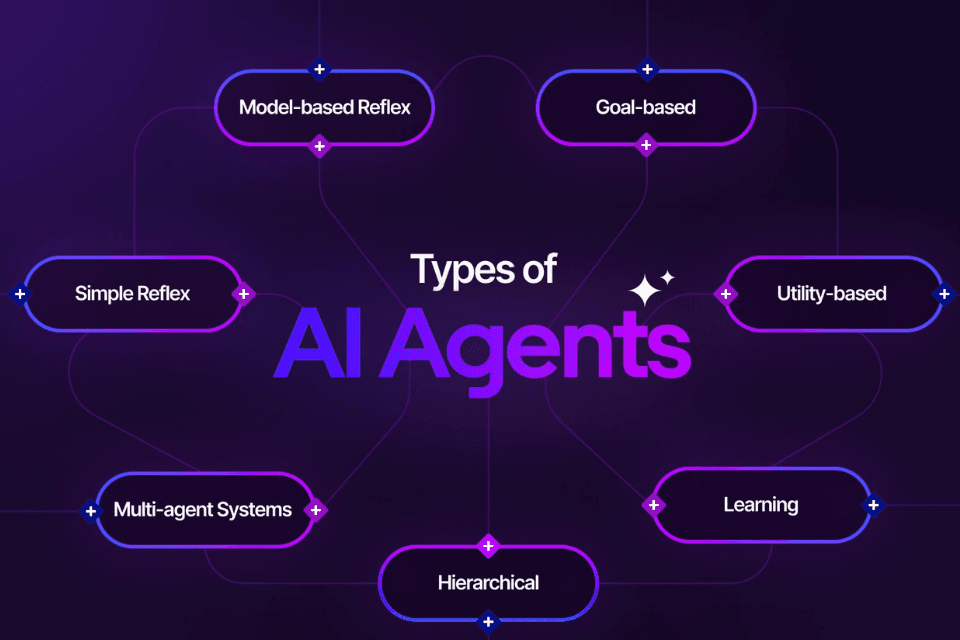
There are five foundational types of AI agents, each representing a distinct level of intelligence and decision-making capability. A sixth category — multi-agent systems — describes how all five are combined in production deployments.
| Type Of AI Agents | Core Mechanism | Memory | Planning | Learning |
|---|---|---|---|---|
| Simple Reflex Agent - Level 1 | If-then condition-action rules, no history | None | None | None |
| Model-Based Reflex Agent - Level 2 | Condition-action rules + internal world model | Internal state | Limited | None |
| Goal-Based Agent - Level 3 | Evaluates actions against an explicit goal or objective | Internal state | Yes | None |
| Utility-Based Agent Level 4 | Maximizes a utility function across competing trade-offs | Internal state | Yes | Limited |
| Learning Agent - Level 5 | Updates behavior from feedback; improves over time | Persistent | Yes | Yes |
| Multi-Agent System - Level 6 | Orchestrated network of agents, each type contributing a capability | Distributed | Hierarchical | Collective |
03. Simple Reflex Agents:
React to what they sense right now — nothing more, nothing less.
A simple reflex agent is the most basic type of AI agent, designed to respond directly to its current observable environment using predefined condition-action rules — commonly expressed as "if-then" logic. It does not consider what happened in the past, what might happen in the future, or whether its current action serves any larger objective. Its entire decision-making process can be expressed as: if [condition is true], then [take this action].
The key mechanism is the performance element — the component that processes sensor input and triggers the actuator response. There is no internal state, no world model, no planning. Because of this, simple reflex agents can only function correctly in fully observable environments: situations where the sensor data available to the agent is sufficient to determine the correct action without needing to infer anything that isn't directly visible.

3.1. Real-World Examples:
I) Thermostats and HVAC Controllers:
- The canonical simple reflex agent: if temperature drops below a threshold, turn the heater on; if it rises above another, turn it off. No memory of whether the heater was on five minutes ago. No plan for the rest of the day. Pure condition → action.
II) Factory Safety and Quality Control:
- Production-line sensors that divert underweight products off the conveyor, shut down machinery if heat or vibration exceeds a threshold, or activate filters when air-quality sensors detect particles above a safe level. IBM's documentation highlights these as the primary modern deployment context for simple reflex agents, noting that they "help ensure safety through monitoring systems" and can shut down "automatically if a sensor detects excessive heat or vibration" because these decisions "don't depend on memory or prediction" and therefore "operate reliably in real time."
III) Automatic Traffic Light Systems:
- A signal that adjusts in response to traffic sensor inputs without reference to past traffic states — green when sensors detect cars waiting, cycling without awareness of what phase it was in ten minutes ago.
IV) Strengths:
- Computationally lightweight — minimal processing power and memory required
- Near-instantaneous response — no complex reasoning to complete first
- Perfectly consistent — same input always produces the same output
- Low cost to deploy and maintain; no large datasets or ML algorithms required
- Highly reliable as a last line of defense in a layered multi-agent system
V) Limitations:
- Cannot function in partially observable environments where context is needed
- No memory — cannot avoid repeating mistakes or recognize patterns over time
- Inflexible — all behavior must be manually encoded; adapting to new situations requires a human to add new rules
- Cannot pursue long-term objectives or make trade-offs
- Assumes sensor data is always accurate — no mechanism to handle uncertain or noisy input
04. Model-Based Reflex Agents:
Like a simple reflex agent, but it remembers what the world looked like a moment ago.
A model-based reflex agent is a more advanced version of the simple reflex agent. It still uses condition-action rules to decide what to do, but it adds a crucial new component: an internal model of the world. This internal model allows the agent to track the current state of the environment over time, taking into account how its previous actions affected that state and how the world tends to evolve independently of its actions.
This matters in situations where the sensor reading alone is insufficient to determine the right action — what engineers call partially observable environments. A simple reflex agent seeing an obstacle would always react the same way. A model-based agent knows whether it has already passed that obstacle on the left during the last loop and can make a more informed decision about which way to go.

4.1. Real-World Examples:
I) Robotic Vacuum Cleaners:
- A robot vacuum maintains an internal map of the room, tracking which areas it has already cleaned and remembering obstacles it has already navigated around. Unlike a simple reflex vacuum that would react only to what its sensor detects right now, the model-based vacuum makes decisions based on where it has already been, enabling systematic room coverage rather than random wandering.
II) Industrial Machine Monitoring:
- IBM's documentation illustrates this with a factory industrial press scenario: a simple reflex agent would shut down the machine the moment the temperature exceeded 100°C, even during normal warm-up phases. A model-based reflex agent knows whether the machine just started (where a temperature spike is normal) versus whether it has been running for an hour (where the same spike is genuinely dangerous). The internal state — specifically, how long the machine has been running — changes which action is correct for the same sensor reading.
III) Strengths:
- Can function in partially observable environments by tracking what it cannot currently see
- More contextually appropriate responses — the same sensor reading can trigger different actions based on history
- Avoids repeating errors that result from ignoring past state
- Still relatively simple to implement and computationally efficient compared to goal-based or learning agents
IV) Limitations:
- Still governed by condition-action rules — cannot pursue long-term objectives or plan toward a goal
- World model quality directly limits decision quality; an inaccurate model leads to worse decisions than a well-tuned simple reflex agent
- Lacks advanced reasoning or learning; cannot adapt to genuinely novel situations beyond what the rules encode
05. Goal-Based Agents:
Not "what do I do right now?" but "what should I do to get where I'm going?"
A goal-based agent extends reflex agent capabilities by introducing an explicit objective. Rather than selecting the action that matches a condition-action rule, it evaluates possible actions based on which one is most likely to move it closer to an explicitly defined goal. This proactive, goal-oriented approach to problem-solving requires the agent to reason about future states — to think not just about the current situation but about where each possible action leads.
The shift from reflex to goal-based is a shift from reactive to deliberative architecture. A reflex agent responds to what is. A goal-based agent plans toward what should be. This typically involves some form of search or planning algorithm: the agent builds a sequence of actions it expects will lead to the goal state, then executes that sequence, adapting if a step fails. IBM describes goal-based agents as sitting "squarely in the middle" of the hierarchy — more capable than reflex agents, but less sophisticated than utility-based agents that trade off between competing objectives.

5.1. Real-World Examples:
I) Navigation Robots:
- A warehouse robot to reach shelf B7 doesn't just react to obstacles — it plans a route, evaluates which path minimizes travel time given known obstacles, and replans if a previously known route is now blocked. The goal (reach B7) drives every action selection decision.
II) Hospital Patient Scheduling:
- A scheduling agent with a goal of completing a patient's full treatment plan evaluates appointments, lab orders, and medication timings to find sequences that satisfy all medical dependencies. If a lab result is delayed, it re-plans the remaining steps around the new constraint rather than failing the entire schedule.
III) Autonomous Vehicle Route Planning:
- Route-planning systems in self-driving cars select driving actions based on reaching a destination, evaluating alternative paths when roads are blocked and choosing actions that move toward the navigation goal — not simply reacting to what a sensor detected in the last 100 milliseconds.
IV) Strengths:
- Can pursue long-term objectives, not just immediate reactions
- Adapts plans when steps fail rather than stopping entirely
- Handles more complex, multi-step tasks than reflex agents
- Greater foresight — considers future states, not just current ones
V) Limitations:
- Often relies on preprogrammed strategies or decision trees — limited flexibility when novel situations arise outside those strategies
- Cannot make nuanced trade-offs when multiple valid goals or competing objectives exist
- Computationally more expensive than reflex agents, especially in large state spaces
06. Utility-Based Agents:
Not just "does this achieve the goal?" but "which way of achieving it is best?"
A utility-based agent goes beyond the goal-based agent by recognizing that not all outcomes are equally good — even when they both technically "achieve the goal." Where a goal-based agent makes a binary evaluation (does this action lead to the goal or not?), a utility-based agent assigns a numerical utility value to each possible outcome and selects the action that maximizes expected utility across all relevant factors.
This is the agent type that handles trade-offs. When a goal-based agent reaches a junction, and both roads lead to the destination, it might pick either one arbitrarily. A utility-based agent evaluates road A (faster, higher fuel cost, more traffic risk) versus road B (slower, lower fuel cost, safer) and picks the one that scores highest on its utility function — a weighted combination of everything it cares about. The utility function is the mechanism that encodes the agent's "preferences" as mathematics, translating qualitative priorities into comparable numerical scores.

6.1. Real-World Examples:
I) Self-Driving Vehicles:
- When a self-driving car navigates a route, it's not simply choosing the fastest path to the destination (that would be goal-based). It simultaneously evaluates speed, fuel efficiency, passenger safety, traffic risk, and comfort trade-offs. The utility function determines how much weight to give to each factor in different contexts — driving on a highway versus navigating a school zone — producing different behavior from the same underlying architecture.
II) E-Commerce Pricing and Recommendation Engines:
- IBM's documentation describes this directly: a utility-based agent in e-commerce evaluates pricing decisions by weighing sales history, customer preferences, inventory levels, margin targets, and competitive pricing simultaneously. Rather than simply recommending the highest-margin item or the most popular item (either would be goal-based with a single objective), it finds the product recommendation or price point that maximizes a composite utility across all these factors at once.
III) Hospital Bed Assignment Optimization:
- A hospital bed assignment agent doesn't just find an available bed — it finds the best one given patient isolation needs, proximity to required equipment, nursing staff distribution, infection control considerations, and patient acuity. Each of these factors has a different weight in the utility function; the agent assigns every possible assignment a utility score and picks the highest.
IV) Strengths:
- Handles competing objectives and real-world trade-offs naturally
- More nuanced decisions than binary goal-achievement
- Adapts behavior to context when utility weights can change
- Directly encodes organizational priorities into decision-making
V) Limitations:
- Designing accurate utility functions is genuinely difficult — it requires careful calibration of weights and factors
- Poorly designed utility functions produce systematically wrong decisions, potentially worse than simpler agents
- Computationally intensive in large action spaces where many outcomes must be evaluated
- Does not improve its utility function through experience — that requires a learning agent
07. Learning Agents:
The only type that becomes better at its job simply by doing it.
A learning agent improves its performance over time by adapting to new experiences and data. Unlike all the agent types below it on the hierarchy — which rely on fixed rules, fixed models, or fixed utility functions — a learning agent continuously updates its own behavior based on feedback from the environment. This ability allows it to enhance its decision-making in dynamic, uncertain situations that were not fully anticipated at design time.
IBM identifies four internal components that every learning agent possesses, working together in a continuous improvement cycle:

In practice, the most common realization of this architecture in 2025/2026 is reinforcement learning: the agent tries actions, receives rewards for correct results and penalties for incorrect ones, and over time learns which actions yield the highest expected rewards in which situations. Modern LLM-based agents are trained using variants of this feedback loop (RLHF — Reinforcement Learning from Human Feedback), making every frontier AI model in production today a form of learning agent.
7.1. Real-World Examples:
I) Persistent Chatbots and Customer Service AI:
- A customer service chatbot trained on interaction logs and customer satisfaction scores improves its response quality over time. Natural language processing analyzes user behavior to predict what answers will resolve queries, and the agent refines its strategies as new interaction data accumulates — something a simple reflex or goal-based chatbot cannot do.
II) Social Media Content Recommendation:
- Recommendation algorithms on social platforms are learning agents: they observe which content a user engages with, which they skip, how long they watch, and update their recommendation strategy continuously. The agent's goal is implicit — maximize engagement — and it learns which content choices achieve that goal for each user over millions of interactions.
III) Autonomous Driving Systems:
- Autonomous vehicles collect sensor data from millions of real-world miles, feed it back into training pipelines, and improve their driving models continuously. Each edge case encountered in the field — an unusual road marking, an unexpected pedestrian behavior — becomes a training example that refines the agent's decision-making for future encounters.
IV) Strengths:
- Improves continuously without manual rule updates
- Handles genuinely novel situations over time as they are encountered and learned from
- Most flexible and capable agent type — can approach complex, ever-changing problems
- Can discover strategies that human designers did not explicitly encode
V) Limitations:
- Most complex and computationally expensive agent type to build and deploy
- Requires significant training data and feedback loops to improve effectively
- Can learn incorrect or harmful behaviors if the reward signal is poorly designed
- Behavior can be harder to predict and audit than rule-based agents
- Initial performance before sufficient learning may be poor
08. Multi-Agent Systems:
Where all five types work together — each doing what it does best.
A multi-agent system (MAS) is a network of individual AI agents — typically drawing from multiple types in the hierarchy — working together under some form of coordination to accomplish goals that exceed what any single agent could achieve alone. As AI systems become more complex, the need for this kind of hierarchical, distributed architecture arises naturally: some tasks are too large, too diverse, or too demanding to be handled by a single agent, regardless of how sophisticated that agent is.
In a MAS, agents coordinate through communication protocols and shared data structures. Some architectures are hierarchical: a conductor or orchestrator agent at the top breaks down the overall goal and delegates subtasks to specialized subagents, collecting and synthesizing their results. Others are decentralized: agents communicate horizontally as peers, sharing information and collectively arriving at decisions through negotiation or consensus mechanisms.

8.1. The Smart Factory — IBM's Canonical Example:
- IBM's documentation describes a smart factory as the clearest illustration of all five types working together in one coordinated system. Simple reflex agents handle immediate safety — if a machine temperature exceeds its threshold, it shuts down instantly, no reasoning required. Model-based reflex agents sit above them, maintaining an internal model of machine states and detecting when maintenance is needed before a failure occurs. Goal-based agents optimize production schedules and drive specific output targets. Utility-based agents weigh energy consumption, cost efficiency, and throughput against each other and select the combination that maximizes the factory's overall performance score. Learning agents analyze production data over time, identify patterns, and propose workflow changes that the other agents couldn't have derived from their fixed rules or utility functions alone. The orchestrator coordinates all five, synthesizing their inputs into factory-wide decisions.
I) Financial Services Orchestration:
- JPMorgan's 450+ active agentic AI deployments are a real-world multi-agent system: specialized agents handle fraud detection (utility-based, weighing risk vs. false-positive rate), M&A document generation (goal-based, reaching a completed document), trade settlement automation (reflex-based, applying settlement rules in real time), and adaptive pricing models (learning agents, updating based on market feedback) — all coordinated under a shared infrastructure that routes tasks to the appropriate agent.
II) Agentic Coding Pipelines:
- Modern agentic coding systems like Kimi K2.6's 300-subagent architecture exemplify MAS in software engineering: one agent decomposes the repository structure, others handle individual file changes, a critic agent reviews each change, a test runner agent validates results, and an orchestrator synthesizes the full changeset. No single agent could plan, execute, test, and review a large codebase refactor; the multi-agent architecture distributes that complexity across specialized agents working in coordination.
III) Strengths:
- Handles goals of arbitrary complexity by decomposing them into specialized subtasks
- Each agent can be optimized for its specific function independently
- Parallel execution across agents dramatically reduces wall-clock time for large workflows
- Failure in one agent can be caught and handled by others
IV) Limitations:
- Errors in one agent propagate to downstream agents — cascading failures are a real risk
- Communication overhead between agents adds latency and complexity
- Orchestration logic is difficult to design and debug when many agents interact
- Much harder to audit and govern than single-agent systems
- Higher total compute and API cost than any single-agent equivalent
09. Final Thoughts:
The five-type taxonomy of AI agents isn't just an academic classification — it's a practical decision framework. Every AI agent in production today sits somewhere on this hierarchy, and choosing the wrong type for a given problem has real consequences: a simple reflex agent asked to handle a partially observable environment will fail consistently; a learning agent deployed in a context that requires perfect consistency will be unnecessarily expensive and unpredictable. The design decision is always: what is the minimum level of agent sophistication that correctly solves this problem?
In 2026, the most significant development in this space is the maturation of multi-agent systems as production infrastructure — not just research demonstrations. Smart factories, financial services orchestration, healthcare documentation, and agentic coding pipelines are all real deployments of MAS at enterprise scale, combining the five types in coordinated architectures where each agent handles the part of the task best suited to its design. The orchestration frameworks that make this possible — LangGraph, crewAI, AutoGen, and IBM's own watsonx Orchestrate — have matured from experimental tools to production-tested platforms with governance, observability, and compliance capabilities built in.
Where this is heading: the boundaries between agent types are blurring. Modern LLM-powered agents combine elements of model-based reasoning, goal-oriented planning, utility-aware trade-off evaluation, and learning from feedback into a single system, because LLMs inherently generalize across these capabilities rather than implementing any one in isolation. The classical five-type framework remains the clearest conceptual map for understanding what any agent is designed to do — but the systems built on top of frontier LLMs in 2026 are increasingly composite, drawing on all five capabilities simultaneously, with the orchestration layer determining which capability is activated for which part of a given task.