Components of AI Agents
7 blocks: see, plan, remember, reason, act, talk, learn. Together, they drive autonomous AI goals.
AI agents are no longer niche research systems — in 2026, they're making decisions inside hospitals, processing millions of financial transactions, managing supply chains, and writing production software autonomously. But understanding what makes an agent capable of doing any of this — what components have to be present and working together before an AI can genuinely act on your behalf — is still something most practitioners skip. That gap matters. An organization that doesn't understand how agent memory works will build agents that forget context at the worst moment; one that doesn't understand tool calling will build agents that confidently reason about outdated training data when they could simply look the answer up. This guide covers all seven core components from first principles: where IBM and the broader research community define them, how they're implemented in modern frameworks like LangChain and LangGraph, and what breaks when any single component is missing or poorly designed.
01. What Are the Components of AI Agents?
AI agents make intelligent decisions and interact seamlessly with digital systems, requiring minimal human intervention. But what makes these agents truly intelligent? At their core, AI agents rely on a set of interconnected components that enable them to perceive their environment, process information, decide, collaborate, take meaningful actions, and learn from their experience.
These components are not modular add-ons — they form a continuous cycle. The agent perceives an input, holds it in memory, plans a response, reasons about options, acts through tools, communicates its output, and updates its own behavior through learning. Remove any one component and the system degrades in a specific, predictable way: without memory, the agent loses context across steps; without tool calling, it's limited to its training data; without learning, it can't improve from mistakes; without reasoning, it can't evaluate competing options.

The behavior of agents is governed by the architecture in which they operate. Reactive agents at the simpler end may only use perception and a fixed action module — no memory, no planning, no learning. Cognitive agents at the advanced end use all seven, with sophisticated versions of each. The sections below cover each component in depth, explaining not just what it does but how it's actually implemented in 2026, which technologies power it, and what breaks when it's absent or poorly designed.
Perception:
Receives and pre-processes inputs from the environment — text, images, audio, structured data, sensor readings, API responses.
Planning:
Breaks complex goals into ordered subtasks, establishes dependencies, and produces a sequence of actions the agent can execute.
Memory:
Stores and retrieves context across steps and sessions — from immediate conversation context to long-term knowledge bases.
Reasoning:
Evaluates options, applies logic, weighs probabilities, and selects the best course of action given available information.
Action & Tool Calling:
Executes decisions by calling external APIs, running code, querying databases, searching the web, or operating physical devices.
Communication:
Generates natural language output for users and exchanges structured messages with other agents through protocols like A2A and MCP.
Learning:
Updates behavior based on feedback — supervised, unsupervised, and reinforcement learning — improving over time without reprogramming.
02. Perception & Input Handling:
How the agent receives and makes sense of its environment before doing anything else.
Agentic AI must be able to ingest and interpret information from various sources. Inputs can come in different forms: user queries, system logs, structured data from APIs, sensor readings, image streams, audio signals, or documents. The agent must parse and understand this information before any planning or reasoning can take place. The perception module is therefore the first point of failure in an agentic system — a misinterpretation here propagates through every downstream component, and there's no correction mechanism unless the agent's reasoning is explicitly designed to question the quality of its inputs.
2.1. Multimodal Input Handling:
The complexity of the perception module depends on the agent's purpose. A customer service chatbot relies on natural language processing (NLP) to interpret text-based queries. A self-driving car's perception module processes camera feeds, LIDAR data, and radar signals simultaneously, using multisensor fusion and computer vision to build a real-time model of the environment. In 2026, most frontier LLM-based agents are natively multimodal: models like Gemini 3.1 Pro, Llama 4, and MiniMax M3 accept text, image, audio, and video in a single prompt, enabling agents to reason across input types without needing separate processing pipelines for each.

2.2. Pre-Processing and Real-Time Filtering:
After raw data is received, the perception module cleans, processes, and structures it into a usable format. The specific transformations vary by input type: speech-to-text conversion for audio, object detection and scene parsing for images, sentiment analysis and entity recognition for text, and anomaly detection for time-series sensor data. In real-time AI systems, perception must also be efficient and adaptive — filtering out noise and prioritizing relevant information before it reaches the planning or reasoning module. The accuracy and robustness of this module directly impact the agent's effectiveness downstream; misinterpretations in perception can lead to incorrect decisions and actions that the agent then executes with full confidence.
Prompt engineering intersects with perception: well-structured prompts can guide how an agent processes and prioritizes its input context, effectively acting as a perception layer for LLM-based agents where the raw "sensor" is the user's text input.
03. Planning & Task Decomposition:
Turning a goal into an executable sequence of steps.
Unlike reactive agents that respond instinctively to immediate inputs, planning agents map out sequences of actions before execution. This module is critical for AI applications such as autonomous robots, logistics optimization, agentic coding systems, and AI-driven scheduling. After understanding the input, the agent needs to break complex problems into smaller, manageable tasks — determining the sequence of actions and the dependencies between them before executing the first one.
3.1. Planning Strategies:
Chain-of-Thought (CoT)
The agent reasons step-by-step through a problem, generating each intermediate reasoning step as text before producing a final answer. This improves accuracy on complex multi-step tasks by making the agent's logic explicit and inspectable. CoT is built into most frontier LLMs via system prompt instructions or dedicated reasoning modes.
Tree-of-Thought (ToT)
Rather than committing to a single reasoning chain, the agent explores multiple possible reasoning paths in parallel — like a decision tree — and evaluates which branches lead most promising toward the goal. ToT is especially useful for tasks with many valid approaches, such as mathematical problem-solving or strategic planning.
Plan-and-Execute
The agent first generates a complete plan — a structured list of subtasks — and then hands that plan to an execution engine that carries out each step. This is the ReWOO pattern: separating planning from execution allows the agent to use a smaller, faster model for routine execution steps and reserve expensive reasoning calls for the planning phase.
Hierarchical Planning
In multi-agent systems, planning becomes distributed: an orchestrator agent produces a high-level plan, then delegates subtasks to specialized subagents, each of which may run their own local planning cycle. This hierarchy allows complex, multi-domain goals to be pursued without any single agent needing to hold the entire problem in scope.
Effective planning also incorporates uncertainty. Rather than assuming every step will succeed, robust planning agents use probabilistic models to prepare for unexpected events — if step three fails, the planner re-runs and produces an adapted sequence rather than halting the entire workflow. In multi-agent systems, planning becomes even more sophisticated as agents must coordinate or negotiate for shared resources while each pursues its own assigned subtask.
Without a robust planning module, an agent might struggle with long-term tasks, fail to optimize processes, or become inefficient when dealing with changing conditions — it reacts to each moment in isolation rather than executing coherently toward a goal.
04. Memory:
What the agent knows, when, and for how long.
Memory is the component that enables the AI agent to retain and recall information, ensuring it can learn from past interactions and maintain context over time. LLMs cannot, by themselves, remember things — the memory component must be added externally. This is one of the most commonly misunderstood architectural points: a base LLM resets completely between sessions unless memory infrastructure is built around it. Without an efficient memory module, an agent functions statelessly, forcing users to repeat information with every interaction and making long-horizon autonomous tasks impossible.
Researchers categorize agentic memory in much the same way that psychologists categorize human memory. The influential Cognitive Architectures for Language Agents (CoALA) paper from Princeton University identifies five distinct memory types, each serving a different function in the agent's overall intelligence.

4.1. The Five Memory Types:
Short-Term Memory
Session Context:
- Stores recent inputs for immediate decision-making. A chatbot using short-term memory can maintain coherence across a conversation, referring back to what the user said three messages ago. Implemented using a rolling buffer or a context window — typically the in-context portion of the LLM's attention. Once the session ends, this memory is cleared.
- context window · rolling buffer
Long-Term Memory
Cross-Session Knowledge:
- Stores and recalls information across different sessions, enabling personalization and historical knowledge. Unlike short-term memory, long-term memory is designed for permanent or semi-permanent storage. Retrieval-augmented generation (RAG) is one of the most effective techniques for implementing long-term memory — the agent fetches relevant information from a stored knowledge base to enhance its responses.
- vector databases · knowledge graphs
Episodic Memory
Specific Past Events:
- Allows agents to recall specific past experiences — analogous to how humans remember individual events. An AI financial advisor might remember a user's past investment choices and use that history to provide better recommendations. Implemented by logging key events, actions, and their outcomes in a structured format that the agent can access when making decisions.
- event logs · structured history
Semantic Memory
Structured Facts & Rules:
- Stores generalized factual knowledge the agent can retrieve for reasoning — facts, definitions, and domain rules. Unlike episodic memory (which stores specific events), semantic memory contains general knowledge. Used in real-world applications requiring domain expertise: legal AI assistants, medical diagnostic tools, and enterprise knowledge management. Implemented using knowledge bases, symbolic AI, or vector embeddings.
- knowledge bases · vector embeddings
Procedural Memory
Learned Skills and Behaviors:
- Stores and recalls skills, rules, and learned behaviors that enable an agent to perform tasks automatically without explicitly reasoning each time — analogous to how humans can ride a bike without consciously working through every step. In AI, procedural memory helps agents reduce computation time by automating complex sequences of actions based on prior experiences. Implemented through model weights themselves and through reinforcement learning-trained policies.
- model weights · RL policies
4.2. Memory in Practice: LangChain and LangGraph:
LangChain is a key framework for building memory-enabled AI agents, facilitating the integration of memory with APIs and reasoning workflows. By combining LangChain with vector databases such as Pinecone, Weaviate, or Chroma, agents can efficiently store and retrieve large volumes of past interactions. LangGraph extends this by allowing developers to construct hierarchical memory graphs — structures that track dependencies across steps and learn relationships over time — useful for AI-driven document generation, code review workflows, and anything requiring the agent to remember its own prior decisions.
05. Reasoning & Decision-Making:
How the agent evaluates options and chooses what to do next.
At the core of every AI agent is its reasoning module. This module determines how an agent reacts to its environment by weighing different factors, evaluating probabilities, and applying logical rules or learned behaviors. The simple chatbots of the previous decade used predefined rules to choose from a narrow set of decisions. More advanced AI agents evaluate different solution paths, assess their performance against a goal, and refine their approach over time. The agent's ability to effectively reason and make informed decisions determines its overall intelligence and reliability in handling complex tasks.
5.1. Reasoning Paradigms in 2026:

ReAct (Reasoning and Action):
The agent alternates between reasoning and acting in a tight Thought → Action → Observation loop. Because it reasons fresh after every tool call, it can adapt mid-task if a search returns unexpected results. Best for dynamic, interactive workflows where the next step depends on what each tool returns.
ReWOO (Reasoning Without Observation):
Decouples reasoning from tool execution. The Planner produces a complete plan with dependency placeholders, the Worker executes tools in parallel, and the Solver synthesizes results. Reduces LLM calls by 30–50% compared to ReAct on equivalent workflows — best for well-defined, predictable multi-step tasks.
Self-Reflection:
The agent evaluates its own output after generating it — checking for logical consistency, factual support, and alignment with the original goal before presenting a final answer. Self-reflective reasoning is what enables agents to catch hallucinations before they become tool call arguments or user-facing responses.
Critique-Based Reasoning:
A separate "critic" model or agent reviews the primary agent's output and provides structured feedback. The primary agent then revises based on that feedback. Common in multi-agent agentic coding pipelines (e.g., Kimi K2.6's architecture) where one subagent writes code and another reviews it before submission.
Simple AI systems follow predefined if-then logic. More advanced systems use Bayesian inference, reinforcement learning, or neural networks to adapt dynamically to new situations. This module can also implement chain-of-thought reasoning and multistep problem-solving techniques, which are essential for AI applications such as automated financial analysis, legal contract review, and autonomous software engineering.
06. Action & Tool Calling:
How the agent reaches beyond its training data to interact with the real world.
The action module implements the agent's decisions in the real world — allowing it to interact with users, digital systems, and even physical environments. After the reasoning and planning modules determine an appropriate response, the action module executes the necessary steps, whether that's calling an API, querying a database, writing a file, running code, or sending a communication.
Tool calling is the specific mechanism through which an LLM-based agent invokes external tools, APIs, or functions to extend its capabilities beyond its native knowledge. Without tool calling, an LLM is limited to its static training data — frozen at a point in time, unable to check live prices, read a database, or run a computation. Tool calling transforms a passive language model into a proactive digital agent capable of acting on real information in real time.
6.1. How Tool Calling Works — The Six-Step Sequence:
I) Recognizing the Need for a Tool:
- The agent uses its natural language understanding to recognize that real-time data or an external function is needed — something it cannot answer from training data alone. A unique tool call ID is assigned automatically to track the request.
II) Selecting the Right Tool:
- The agent identifies the best tool for the task from its available tool schema — a structured definition of each tool's name, description, parameters, and expected input/output types. Combining tool calling with RAG enhances this step by allowing the agent to retrieve relevant context before selecting the appropriate tool.
III) Constructing and Sending the Query:
- The agent formulates a structured request matching the tool's schema — supplying the correct arguments, API key if required, and endpoint. Most tool calls are HTTP requests in JSON format. Templates help the model produce correctly structured arguments without requiring the agent to "know" the API documentation itself.
IV) Receiving and Processing the Response:
- The external tool returns data. The agent parses the result — a JSON schema object, a code execution output, a database result set — and filters and structures it into a format suitable for the next reasoning step.
V) Acting or Presenting Information:
- The agent delivers the processed information in a useful form, or — in agentic workflows — uses the result to make the next decision, call the next tool, or trigger the next subtask without waiting for user input.
VI) Refining or Iterating
- If the result is incomplete or the user requests further detail, the agent repeats the process with an adjusted query — the iteration capability that makes tool calling a dynamic loop rather than a single lookup.
6.2. Types of Tools Agents Call:
I) Information Retrieval:
- Web search APIs, academic databases, news APIs, financial market feeds — fetching real-time data the agent couldn't have in its training set.
II) Code Execution:
- Python interpreters, mathematical engines like Wolfram Alpha, sandboxed execution environments — running computations the LLM can't perform natively.
III) Process Automation:
- Calendar APIs, email systems, CRM platforms, Zapier integrations — taking actions in business systems on the user's behalf.
IV) Database Queries:
- SQL databases, vector databases, document stores — retrieving structured organizational data that's proprietary to the organization and not in any public dataset.
07. Communication:
How agents talk — to users, to each other, and to external systems.
The communication module enables an agent to interact with humans, other agents, or external software systems, ensuring seamless integration and collaboration. This module handles natural language generation (NLG) — producing coherent, context-appropriate responses — and protocol-based messaging — exchanging structured information with other systems in machine-readable formats. In simple agents, communication follows predefined scripts. Advanced agents use generative AI models trained on vast datasets to generate dynamic, context-aware responses that adapt in tone, format, and depth to the recipient.
7.1. Types of Communication:
I) Human-AI Communication:
- Agents use NLP, speech recognition, and visual interfaces to interact with humans. In customer support, chatbots interpret user queries and generate conversational responses. Challenges include correctly interpreting sarcasm, regional dialects, implicit requests, and emotional context that the agent's training data may not have covered.
II) Agent-to-Agent Communication
- Most agents powered by LLMs can communicate with each other in natural language. More efficient inter-agent communication mechanisms are under active research — Microsoft's DroidSpeak paper, for instance, aims to enable agents to share intermediate model activations directly, enabling faster communication with minimal loss of accuracy.
7.2. Agent Communication Protocols:
As multi-agent systems become production infrastructure, the need for standardized communication protocols has become urgent. Without them, agents operating across different platforms use incompatible data formats and messaging schemas, creating integration failures. Three major protocols define the 2026 landscape:
Anthropic · 2024
Model Context Protocol (MCP):
MCP standardizes how AI models connect to external data sources, tools, and applications. It acts as a universal connector between LLMs and external systems — databases, APIs, file systems — allowing agents to access resources through a consistent interface regardless of the underlying system.
Google · 2025:
Agent2Agent (A2A):
A2A enables AI agents from different providers and frameworks to discover each other, negotiate capabilities, and securely exchange information. Particularly important when orchestrating mixed ecosystems where, for example, a LangChain agent needs to delegate a subtask to an AutoGen agent or an IBM watsonx agent.
IBM BeeAI · 2025:
Agent Communication Protocol (ACP):
An open, REST-based protocol for multi-agent interoperability with a focus on asynchronous, multi-turn interactions. ACP enables standardized agent discovery and invocation across organizational boundaries, with IBM contributing it to the open-source BeeAI ecosystem.
When agents have the ability to communicate effectively with one another, a multi-agent system becomes more than the sum of its parts. Networked agents share information only they can perceive, divide tasks in parallel, and learn from each other's experience — capabilities that emerge only from communication working correctly across all participating agents.
08. Learning & Adaptation:
The component that makes the agent better tomorrow than it is today.
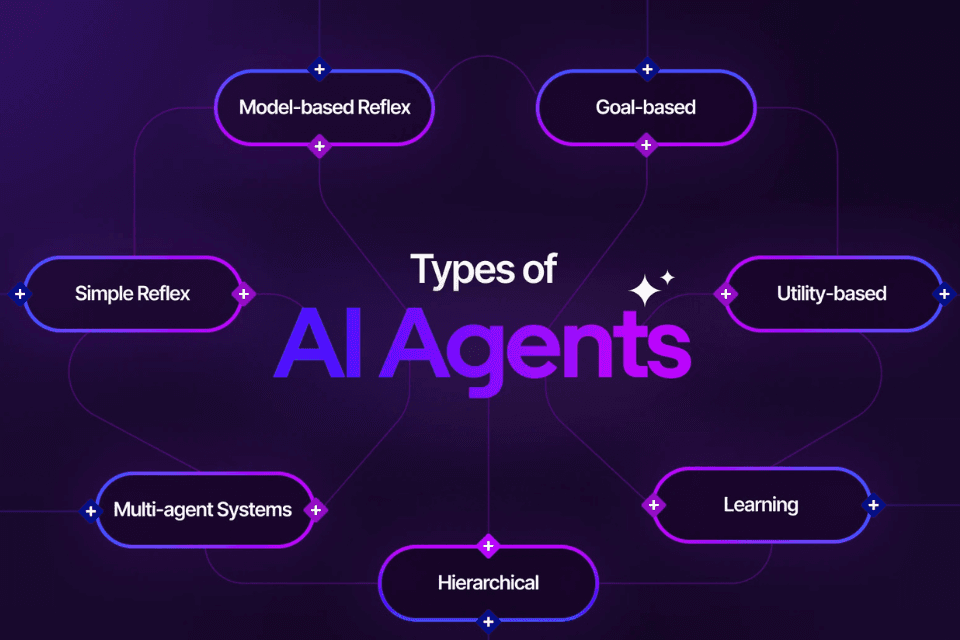
AI agent learning refers to the process by which an agent improves its performance over time by interacting with its environment, processing data, and optimizing its decision-making. This learning process enables autonomous agents to adapt, improve efficiency, and handle complex tasks in dynamic environments. It's important to clarify that not all agent types can learn: simple reflex agents, model-based reflex agents, goal-based agents, and utility-based agents all operate with fixed rules or fixed utility functions that do not update based on experience. Only learning agents — the fifth and highest-complexity agent type — include this component.
8.1. Learning Paradigms:
I) Supervised Learning:
- Training on labeled datasets where each input corresponds to a known output. The agent builds predictive models from labeled examples. In practice: chatbots trained on customer service conversations and resolutions, image classifiers trained on annotated datasets, medical diagnostic models trained on labeled clinical records. Transfer learning allows an LLM pretrained on general data to be fine-tuned for a specific domain.
II) Unsupervised Learning:
- The agent discovers patterns in unlabeled data without direct supervision. Useful for clustering customer behavior, anomaly detection in cybersecurity, and recommendation systems. Self-supervised learning extends this — models like GPT and BERT generate their own supervision signal from unstructured data rather than relying on human labels, enabling training on vastly larger datasets.
III) Reinforcement Learning (RL):
- The agent learns through trial and error in an environment, receiving rewards for correct behavior and penalties for incorrect behavior, then adjusting its policy to maximize cumulative reward. RL drives autonomous vehicle training, game-playing AI, and, critically, the RLHF process that fine-tunes production LLMs to be helpful, harmless, and honest. Unlike supervised or unsupervised learning, RL is specifically about sequential decision-making in uncertain environments.
IV) Continuous Learning:
- The ability of an AI system to learn and adapt over time, incorporating new data and experiences without forgetting previous knowledge — addressing the "catastrophic forgetting" problem where updating on new data erases old knowledge. Continuous learning is essential in real-world applications where data is constantly changing, enabling agents to stay current without full retraining cycles.
8.2. In-Context Learning and RAG-Based Adaptation:
- In 2026, a large portion of agent "learning" in production happens through two mechanisms that don't require retraining the underlying model. In-context learning gives the agent new examples or instructions within the prompt itself — the model adapts its behavior immediately based on what it reads, without any weight updates. RAG-based adaptation updates the external knowledge base the agent retrieves from, effectively changing what the agent "knows" at inference time by changing the documents it can access, not the model itself. These two mechanisms together account for most of the "personalization" and "domain adaptation" seen in enterprise agent deployments today, precisely because they require no ML infrastructure beyond a vector database and a prompt.
8.3. Multiagent Learning:
- In multi-agent systems, agents can learn through collaboration and competition. In cooperative learning, agents share knowledge to achieve a common goal — as seen in swarm robotics and hospital management networks where multiple specialized agents share patient data to collectively improve care. In competitive learning, agents refine their strategies by competing against each other — as in adversarial financial trading AI where agents learn by adapting to strategies deployed by other autonomous agents in the same market.
09. Final Thoughts:
Understanding AI agent components isn't just architectural curiosity — it's the foundation of reliable agentic system design. Each of the seven components described in this guide maps to a specific failure mode when absent or poorly implemented: missing memory causes agents to lose context in the middle of long tasks; inadequate perception causes misinterpretation of inputs that cascades through every downstream decision; a weak reasoning module produces confident but wrong tool call arguments; poor communication design breaks multi-agent coordination at exactly the moment it matters most.
The components that have seen the most rapid evolution from 2025 into 2026 are memory and communication. The five-type memory taxonomy from Princeton's CoALA paper is now the accepted standard across LangChain, LangGraph, AutoGen, and IBM watsonx Orchestrate — it's no longer an academic framework but a practical architecture guide. Communication has moved from a simple NLG module to an inter-protocol ecosystem with MCP, A2A, and ACP creating the first real interoperability layer for multi-agent systems that span organizational and framework boundaries.
Where this is heading: the seven components will increasingly be treated as separate, independently scalable services rather than a monolithic agent binary. Memory will move to specialized vector databases with semantic search. Reasoning will be routed to specialist models — a cheap, fast model for straightforward ReWOO-style planning, a frontier model for complex multi-step critique. Tool calling will be governed by an access-control layer akin to OAuth — an agent that only needs to read a database should not have write access, and that enforcement will happen at the tool call interface. The agents that enterprises trust at scale in late 2026 will be those where every one of these seven components is independently observable, configurable, and auditable — not just "smart enough" to pass a benchmark.